AEO vs SEO: What's the Difference (and Which Do You Need)?
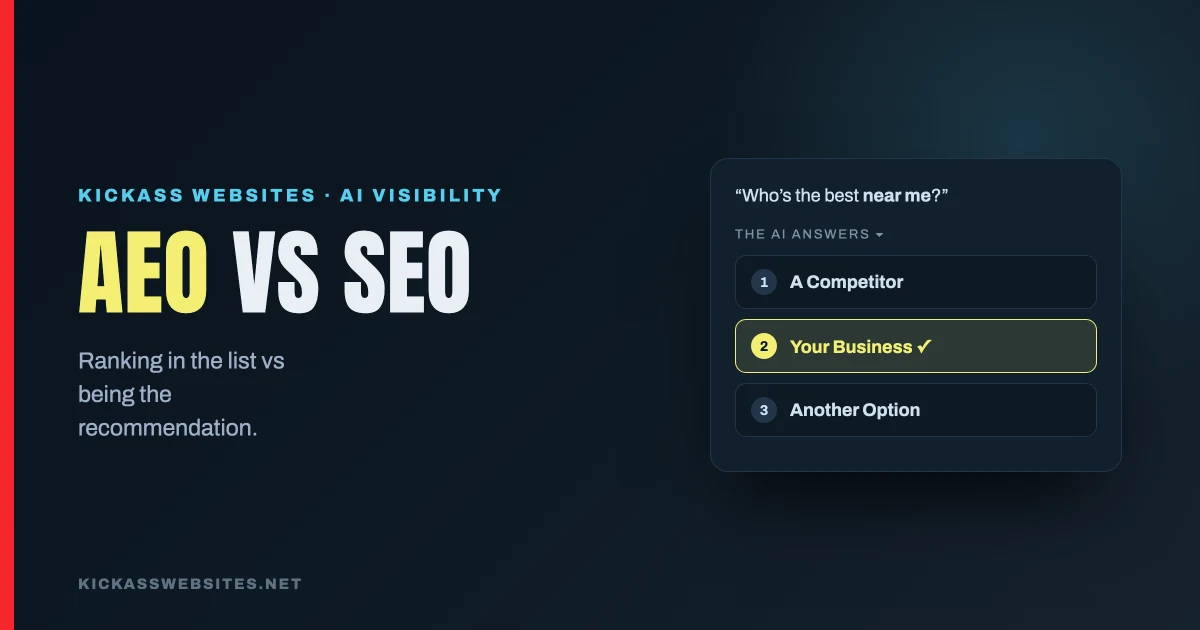
SEO (Search Engine Optimization) gets your website to rank in the list of links on a results page. AEO (Answer Engine Optimization) gets your business named and cited in the answer an AI gives – in ChatGPT, Google’s AI Overviews, Perplexity, or Gemini. They share a foundation, but they aim at two different things: a ranking versus a recommendation. Most businesses need both, and right now most are only doing one.
Here’s the cleanest way to hold the difference in your head: SEO is being on the shelf. AEO is being the one the clerk points to.
The short version
- SEO optimizes for a ranking algorithm. Win = “position 2 for roofer Phoenix.”
- AEO optimizes for a model that reads, summarizes, and recommends. Win = “ChatGPT names you when asked.”
- They overlap: both need a fast, crawlable, trustworthy site. A site invisible to Google is usually invisible to AI too.
- They differ: AEO adds the layer that makes you citable – direct answers, structured data, a consistent business entity, and content the model can lift.
The core difference
A search engine returns a page of options and sends you off to compare them. An answer engine does the comparing for you and returns a verdict – often naming just two or three businesses, with citations.
That changes what “winning” means:
| SEO | AEO | |
|---|---|---|
| You’re optimizing for | A ranking algorithm | A generative model that recommends |
| The win condition | A high spot in the link list | A named mention in the AI’s answer |
| Where you appear | Google/Bing results pages | ChatGPT, AI Overviews, Perplexity, Gemini, Copilot |
| What it rewards | Keywords, backlinks, page authority, relevance | Extractable answers, citations, schema, entity consistency, E-E-A-T |
| The currency | Clicks and traffic | Citations and recommendations |
| How you measure | Rankings, organic sessions, CTR | Share of AI answers that mention you |
| The hard part | Out-competing established sites for the click | Being clear and trustworthy enough to get quoted |
Where AEO and SEO overlap (more than you’d think)
It would be a mistake to treat these as rivals. They’re built on the same ground:
- Crawlability. If a bot can’t read your site, neither Google nor an AI can use it.
- Speed and structure. Fast, well-organized pages help both rankers and summarizers.
- Authority and trust. Real reviews, real credentials, real citations – Google’s E-E-A-T signals – feed both systems.
- Quality content. Useful, accurate, well-supported pages win in both worlds.
In fact, the AI engines are largely trained and grounded on the same open web that Google indexes. That’s why a site with no SEO presence almost never has an AEO presence: the model has nothing trustworthy to pull from. Good SEO is the price of entry to AEO – not a competitor to it.
Where they part ways
AEO adds work that classic SEO never asked for:
- Answer-first formatting. SEO tolerates a 300-word warm-up before the point. AEO punishes it – the model wants the answer in sentence one.
- Citation-worthiness. Ranking rewards links to you; AEO rewards facts, stats, and sources in your content that a model will quote. The GEO research (KDD 2024) found that adding citations, quotations, and statistics lifted AI visibility by up to 40%.
- Entity consistency. SEO cares about your site. AEO cares about your business as the web describes it – every mention, review, and listing, lined up or contradicting.
- Crawler access for AI specifically. Many sites that welcome Googlebot quietly block GPTBot, ClaudeBot, or PerplexityBot. Good for privacy; fatal for AEO.
- A different scoreboard. You can’t track AEO in your rankings tool. You track it by asking the engines and counting your mentions.
”AEO vs SEO” is the wrong framing
The question isn’t which one. It’s both, in the right order.
- If you have no search presence at all, start with the SEO foundation – a fast, crawlable, trustworthy site. AEO has nothing to stand on without it.
- If you already rank but the AIs ignore you, you have an AEO gap: the foundation’s there, but your content isn’t liftable and your entity isn’t consistent. This is the most common case we see, and the cheapest to fix.
- If you’re invisible in both, you do them together – which, for a local business, is genuinely one motion. The signals that win the Google map pack heavily overlap with the signals that win an AI recommendation.
That last point is why, for Valley businesses, we run local SEO in Phoenix and AEO as a single engagement. Different surfaces, mostly the same plumbing.
Which should your business prioritize?
A rough guide:
- Customers ask AI before they call you (home services, contractors, clinics, anything researched) → AEO is urgent, because the recommendation step moved upstream of the click.
- You’re in a fast-growing market with lots of newcomers who don’t have a “guy” yet → AEO, because those buyers are asking AI for the guy.
- You’re starting from zero online → SEO foundation first, AEO layered on as you build – done together.
- You already rank well but feel the AI passing you by → AEO, specifically the citability and entity work.
The fastest way to know which bucket you’re in is to look. Ask ChatGPT, Perplexity, and Google the questions your customers ask. If you rank in Google but never appear in the AI answers, you’ve found your gap.
Bottom line
SEO and AEO aren’t a choice between old and new. SEO keeps you on the shelf; AEO makes you the recommendation. The businesses winning the next few years are doing both – and because so few have started on the AEO half, the businesses that move now get a wide-open field.
If you want the full primer on the new half, read What is Answer Engine Optimization?. If you’re ready to have someone handle it, here’s what our AEO services cover. And if you’ve been hearing GEO instead of AEO, that’s the same work – see GEO services.
Frequently asked questions
Is AEO replacing SEO? No. It’s a layer on top. The AI engines pull from the same web Google indexes, so the SEO foundation still matters – AEO just adds what makes you citable on top of it.
Can I do AEO without doing SEO first? Only if the SEO foundation already exists. A fast, crawlable, trustworthy site is the prerequisite. If yours isn’t there yet, that comes first – there’s nothing for the AI to cite otherwise.
Which is cheaper? For a business that already ranks, the AEO gaps (formatting, schema, entity consistency, crawler access) are often quicker and cheaper to close than chasing rankings. For a business starting from zero, you’re building the foundation either way – so you do both together.
How do I measure AEO if it doesn’t show in my rankings? By asking the engines directly and tracking how often they mention you. A structured AI visibility audit does this across ChatGPT, AI Overviews, Perplexity, and Gemini, and re-runs it over time to show movement.
My competitor ranks below me on Google but the AI recommends them. How? Their content is more liftable, or their business entity is more consistent across the web, or they let the AI crawlers in and you don’t. AEO is a different scoreboard – a lower Google rank can still win the AI answer.
Written by Steve Halverson, founder of Kickass Websites in Phoenix, Arizona. Building websites for local and trade businesses since 2008 – 700+ and counting. Published June 2026.
Find your gap in five minutes – free
We’ll ask ChatGPT, Google’s AI Overviews, Perplexity, and Gemini the questions your customers ask and show you exactly where you rank, where you’re cited, and where you’re missing.
Stop losing jobs to better websites.
We build one that wins the call – live in 48 hours, $497, guaranteed three ways.
Get My Website Live – $497 →