What Is Answer Engine Optimization (AEO)?
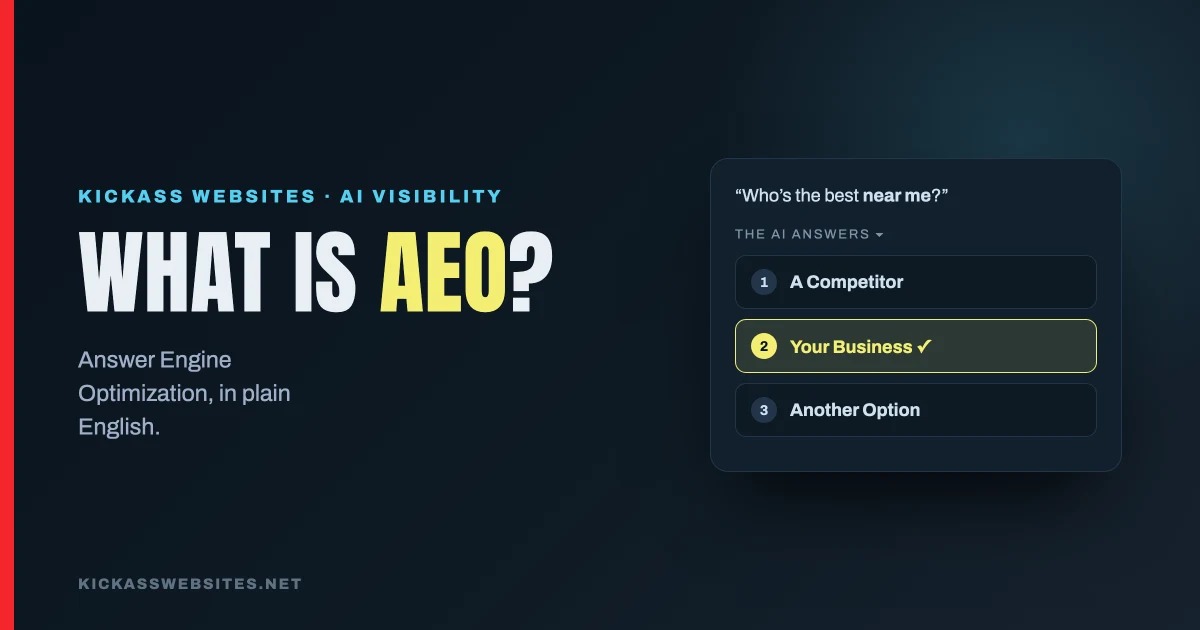
Answer Engine Optimization (AEO) is the practice of structuring your website and your online presence so AI answer engines – ChatGPT, Google’s AI Overviews, Perplexity, Gemini, and Microsoft Copilot – name and cite your business when someone asks them a question. Traditional SEO tries to win a spot in the list of blue links. AEO tries to win the answer itself: the few sentences the AI hands back before the user ever scrolls.
That difference matters more every month. When a customer types “who’s the best HVAC company in Phoenix?” into ChatGPT, they don’t get ten links to compare. They get a short, confident answer naming two or three companies. If you’re one of them, you got the lead. If you’re not, you never existed – and unlike page two of Google, there’s no page two to climb to.
The short version
- Answer engine: any AI tool that replies with a written answer instead of a list of links (ChatGPT, Google AI Overviews, Perplexity, Gemini, Copilot).
- AEO: the work of getting your business included and cited in those answers.
- Why now: Google’s AI Overviews already appear on a large and growing share of searches, and a rising number of buyers ask an AI assistant before they ever open a search engine.
- The risk: AI answers name a handful of businesses, not a page of ten. Being left out is the new being invisible.
What is an “answer engine,” exactly?
A search engine is a librarian: ask a question, get a stack of sources, go read them yourself. An answer engine is more like an expert who already read everything – you ask, and it just tells you, often citing a few sources it leaned on.
The ones your customers are already using:
- ChatGPT (OpenAI) – now with live web browsing, so it can recommend real local businesses.
- Google AI Overviews and AI Mode – the AI-written summary that sits at the very top of Google results, above the regular links.
- Perplexity – a search tool built answer-first, with citations baked into every reply.
- Google Gemini and Microsoft Copilot – built into Android, Chrome, Windows, and Microsoft 365.
These aren’t a far-off trend. They’re the default surface on devices people already own. The phone in your customer’s pocket ships with one of these turned on.
How is AEO different from SEO?
SEO and AEO share a foundation – both reward a fast, crawlable, trustworthy website – but they aim at different targets.
| SEO (Search Engine Optimization) | AEO (Answer Engine Optimization) | |
|---|---|---|
| Goal | Rank in the list of links | Get named and cited in the AI’s answer |
| The result | ”Position 3 for plumber Phoenix" | "ChatGPT recommends you when asked” |
| What it rewards | Keywords, backlinks, page authority | Clear answers, citations, a consistent brand the AI can trust |
| How you measure it | Rankings, clicks, organic traffic | Mentions and citations inside AI answers |
| Who you’re optimizing for | A ranking algorithm | A model that reads, summarizes, and recommends |
The honest take: AEO doesn’t replace SEO – it sits on top of it. A site that’s invisible to Google is usually invisible to AI too, because the models are trained and grounded on the same open web. We get into the full comparison on our AEO vs SEO page. The point here is that ranking #1 and being the recommendation are now two separate jobs, and most businesses are only doing the first one.
How do answer engines decide whom to cite?
Nobody outside the labs has the exact recipe, but the research and the field experience point the same direction. The 2024 study that named the category – “GEO: Generative Engine Optimization” (Aggarwal et al., presented at the KDD conference) – tested what actually moves the needle. The standouts: adding citations, direct quotations, and statistics to a source boosted its visibility in AI-generated answers by up to 40% in some categories. Keyword stuffing did roughly nothing.
In plain terms, answer engines favor content that is:
- Easy to extract. A direct answer in the first sentence, clear question-style headings, short scannable blocks. Models lift answers; make yours liftable.
- Backed up. Facts, numbers, named sources, real dates. Citation-worthy content gets cited.
- Consistent across the web. The model sees your business in many places – your site, Google Business Profile, reviews, directories. When your name, address, phone, and story line up everywhere, the AI trusts the entity. When they conflict, it hedges or skips you.
- Demonstrably credible (E-E-A-T). Real authors, real credentials, real reviews. Google’s own guidance – Experience, Expertise, Authoritativeness, Trust – describes exactly the signals these systems lean on.
- Machine-readable. Structured data (schema markup) spells out for a machine what a human reads at a glance: this is a business, here’s the service, here’s the FAQ, here’s the location.
None of that is a trick. It’s the same thing a good referral source does – give a clear, trustworthy, well-supported answer – aimed at a reader that happens to be a model.
Why AEO matters right now
Three things are happening at once, and they compound:
- The answer is eating the click. When Google hands someone a finished AI answer, a large share of those searches end with no click to any website at all. The traffic you used to earn at position one is increasingly captured before the links even load.
- Buyers are starting at the AI. “Who’s the best near me,” “find me a contractor who does X,” “is this company any good” – these are now AI questions as often as search questions. The recommendation step moved upstream.
- AI answers shortlist; they don’t list. Ten blue links gave ten businesses a shot. An AI answer names two or three. The math of getting found got harder, and the businesses that adapt early get a near-empty field.
For a local business, that last point is the whole game. The AI isn’t going to recommend a company it can’t read, can’t verify, and can’t find consistent information about. Right now, most of your competitors are in exactly that position – which is the opportunity.
What does AEO actually involve?
AEO is a set of moves, not a single switch. The core work:
- An AI visibility audit – find out where (and whether) you currently show up across ChatGPT, Google AI Overviews, Perplexity, and Gemini today. You can’t fix what you haven’t measured.
- Content built to be quoted – direct answers, question-style headings, FAQ blocks, the facts and figures models reach for.
- Structured data – FAQPage, LocalBusiness, Service, and Article schema so machines parse your pages correctly.
- Entity and citation consistency – your name, address, phone, and brand story aligned across your site, Google Business Profile, reviews, and directories.
- Technical AI access – making sure your site actually lets the AI crawlers in (GPTBot, ClaudeBot, PerplexityBot, Google-Extended). A surprising number of sites quietly block the very bots they need.
- Tracking over time – monitoring whether the AIs start naming you, and where you’re still missing.
We break down each of these – and what it costs – on the AEO services page. If the term GEO is what you’ve been hearing instead, that’s the same discipline aimed squarely at generative engines; see GEO services.
AEO for local businesses (the Phoenix angle)
Here’s why this is especially live in a market like Phoenix and across Maricopa County: the Valley is one of the fastest-growing metros in the country, which means two things. New residents who don’t have a “guy” yet – for the AC, the pool, the roof, the remodel – and they’re asking their phone who to call. And a flood of new competitors, most of whom have never heard the term AEO.
A contractor in Mesa or Gilbert who shows up when someone asks Google’s AI “best [trade] near me” is pulling from a pool of buyers who skipped the ten-links-and-compare ritual entirely. The first business in a local category to get its AI visibility right tends to stay the named recommendation for a while, because the models keep reinforcing the entity they already trust. Early is cheap here. Late is expensive everywhere.
This is also why we built our local SEO work in Phoenix and our AEO work as one motion rather than two – for a local business, the AI answer and the map pack are pulling from the same well of signals.
How do you get started with AEO?
- Measure first. Run an AI visibility check – ask the major engines the questions your customers ask, and see whether your name comes up.
- Fix the foundation. A fast, crawlable site with clean structured data and a consistent business entity across the web.
- Build content that answers. Real questions, direct answers, supporting facts – the stuff models cite.
- Open the doors. Confirm the AI crawlers can actually reach your pages.
- Track and adjust. Re-check the engines on a schedule and close the gaps.
You can do this yourself. Most owners don’t have the hours – which is the entire reason the service exists.
Frequently asked questions
Is AEO the same as GEO? Close enough that the terms are often used interchangeably. GEO (Generative Engine Optimization) is the academic name from the 2024 research paper and leans toward generative AI specifically. AEO (Answer Engine Optimization) is the more common business term and covers any answer surface, including Google’s AI Overviews and voice assistants. The work overlaps almost completely. More on GEO services.
Does AEO replace SEO? No. It builds on it. A site that can’t be found or trusted by Google generally can’t be found or trusted by AI either, because they draw on the same web. AEO adds the layer that makes you citable, not just rankable. Full breakdown on AEO vs SEO.
How do I know if AI engines already mention my business? Ask them. Open ChatGPT, Perplexity, and Google, and type the questions a customer would – “best [your service] in [your city],” “is [your company] reputable.” If your name never appears, that’s your starting line. A structured AI visibility audit does this thoroughly across every major engine.
How long does AEO take to work? Faster than classic SEO in some respects – fixing structured data, entity consistency, and crawler access can change what the engines “know” about you within weeks. Building the authority and citations that make you the default recommendation is a longer game, measured in months.
Can a small local business actually compete here? Yes – better than in classic SEO, in fact. National AEO competition is thin, and local AEO competition is nearly nonexistent. Most of your local competitors haven’t started. That’s the window.
Written by Steve Halverson, founder of Kickass Websites in Phoenix, Arizona. Steve has built websites for local and trade businesses since 2008 – 700+ sites and counting – and now helps them get found by customers and by AI. Published June 2026.
See where the AI engines stand on your business – free
We’ll run your business through ChatGPT, Google’s AI Overviews, Perplexity, and Gemini and show you exactly where you show up, where you don’t, and what to fix first. No charge, no pitch you didn’t ask for.
Stop losing jobs to better websites.
We build one that wins the call – live in 48 hours, $497, guaranteed three ways.
Get My Website Live – $497 →