SEO vs AEO vs GEO: What Actually Changed in Search (and What Didn't)
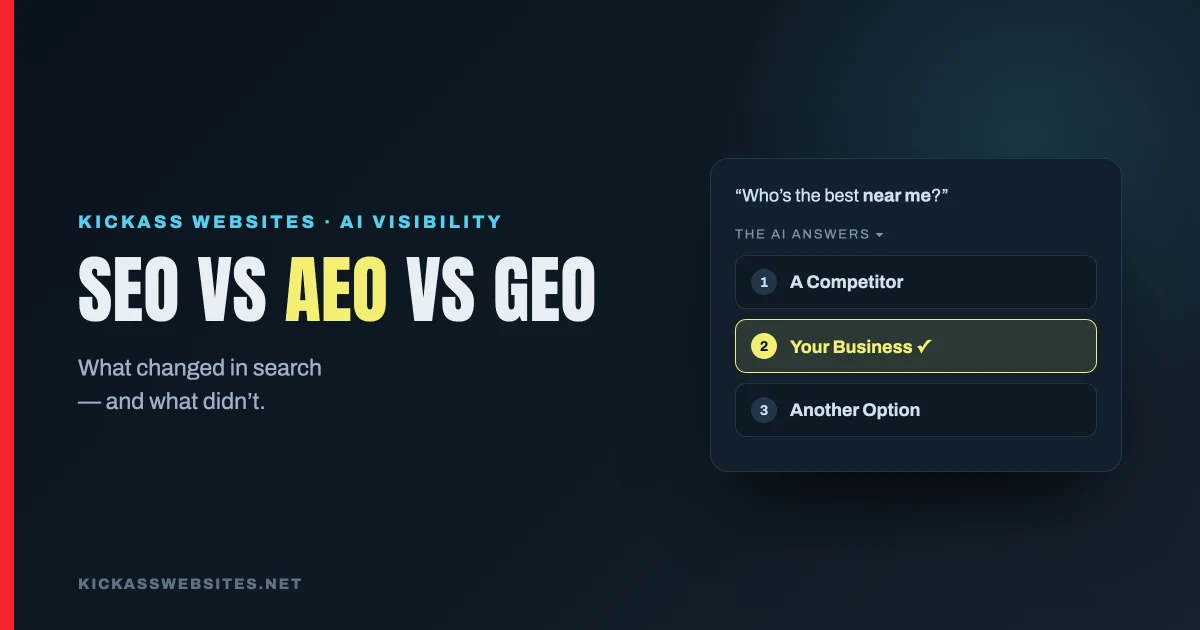
Here’s the honest version, before the acronyms scare anyone off: SEO didn’t die. The rules expanded. SEO (Search Engine Optimization) gets you ranked in the list of links. AEO (Answer Engine Optimization) and GEO (Generative Engine Optimization) – which are nearly the same thing – get you named and cited in the answer an AI gives. All three sit on the same foundation. The difference is that search used to end with a page of links, and increasingly it ends with a written answer – so there’s a new layer of work on top of the SEO you already know.
If you’ve been told “SEO is dead, throw it all out and start over,” you’ve been sold a panic. The fundamentals that made you rank still matter. What changed is that ranking #1 and being the recommendation are now two different jobs, and a growing share of your customers are getting the recommendation from an AI before they ever see your link.
The short version
- SEO → rank in the list of links. (The foundation. Still essential.)
- AEO → get cited in any answer (AI Overviews, voice, generative chat). Business term.
- GEO → get cited specifically in generative engines (ChatGPT, Gemini, Perplexity). Research term. Basically the same work as AEO.
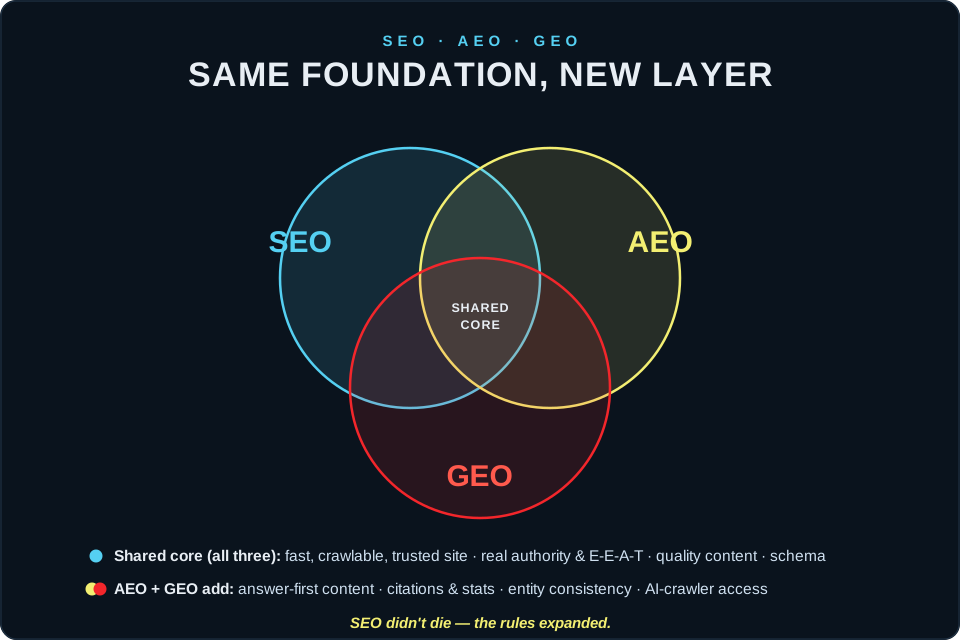
- What’s the same: a fast, crawlable, trustworthy, well-structured site wins all three.
- What’s new: answer-first formatting, citation-worthy facts, a consistent business entity, schema, and letting the AI crawlers in.
- What’s really changed: user behavior – people increasingly take the AI’s answer instead of scrolling links.
The plain definitions
SEO – Search Engine Optimization. The original discipline: make your pages relevant, fast, crawlable, and authoritative so Google and Bing rank them in the organic results. The goal is a high spot in the list of blue links.
AEO – Answer Engine Optimization. Optimizing so your business gets named and cited in a direct answer – Google’s AI Overviews, voice assistants, and AI chat. The goal isn’t a link in a list; it’s being the answer, or one of the two or three sources the answer cites.
GEO – Generative Engine Optimization. The same idea, named from the research side (it comes from a 2024 academic paper) and pointed specifically at generative AI engines like ChatGPT, Gemini, and Perplexity. In practice, AEO and GEO are used interchangeably – we explain the nuance on our GEO services page, but for most business owners they’re one thing.
(You may also start seeing AIO – “AI Optimization” – as a fourth label for the same general space. The acronyms are multiplying faster than the actual techniques. Don’t let the alphabet soup distract you; the underlying work is more stable than the naming.)
SEO vs AEO vs GEO, side by side
| SEO | AEO | GEO | |
|---|---|---|---|
| Full name | Search Engine Optimization | Answer Engine Optimization | Generative Engine Optimization |
| You’re optimizing for | A ranking algorithm | Any answer surface | Generative AI engines |
| The win | A high spot in the link list | Cited in the answer | Cited in the AI’s generated answer |
| Where you show up | Google/Bing results | AI Overviews, voice, chat | ChatGPT, Gemini, Perplexity, Copilot |
| The currency | Clicks & rankings | Citations & mentions | Citations & mentions |
| Origin | Late 1990s | ~2023–24, business term | 2024 research paper, then mainstream |
The table makes them look like three separate things. They’re not. They’re one discipline with a new floor added on top – which is the whole point of this article.
What’s the SAME: the old SEO rules didn’t die
This is the part the hype merchants skip. The AI engines are largely trained and grounded on the same open web that Google indexes. So the work that makes you findable and trustworthy to Google is the same work that makes you usable to an AI. If your SEO foundation is weak, your AEO/GEO presence will be too – the model has nothing solid to pull from.
The fundamentals that still apply, unchanged:
- A clean, fast, crawlable site. If a bot can’t read it, neither Google nor an AI can use it. Still rule number one.
- Authority and trust. Real reviews, real citations, a real reputation – Google’s E-E-A-T signals (Experience, Expertise, Authoritativeness, Trust) – feed every one of these systems.
- Quality, relevant content. Useful pages that actually answer the query win in search and in AI answers.
- Structured data (schema). The labels that tell a machine what you are have only gotten more important, not less.
If you invested in real SEO, almost none of it is wasted. It’s the foundation the new layer stands on.
What’s NEW: the rules layered on top
Here’s what AEO/GEO genuinely add – the work classic SEO never asked for:
- Answer-first formatting. SEO tolerated a 300-word warm-up before the point. Answer engines lift the answer, so it has to come first – direct sentence, clear question-style heading, scannable block. Make your answer liftable.
- Citation-worthiness. The 2024 GEO research (Aggarwal et al., presented at KDD) tested what moves the needle and found that adding citations, quotations, and statistics boosted a source’s visibility in AI answers by up to 40% – while old-school keyword stuffing did basically nothing. Facts get quoted; fluff gets skipped.
- Entity consistency. SEO cares about your site. AEO/GEO care about your business as the whole web describes it – your name, address, phone, and story lined up across your site, Google Business Profile, reviews, and directories. When they conflict, the AI hedges or drops you.
- AI-crawler access. Many sites that happily let Googlebot in quietly block GPTBot, ClaudeBot, or PerplexityBot. Good for privacy; fatal for AI visibility. (There’s even an emerging
llms.txtconvention for guiding these crawlers.) - A different scoreboard. You can’t see AEO/GEO in your rankings tool. You measure it by asking the engines and counting how often they name you.
None of that replaces SEO. It’s a second floor on the same building.
GEO vs SEO, specifically
Because it’s the comparison people search most: GEO doesn’t compete with SEO – it depends on it. SEO earns you the crawlability, authority, and content quality that a generative engine needs before it will trust you enough to cite you. GEO then adds the citation-worthiness and entity consistency that turn “a page Google ranks” into “a source ChatGPT quotes.” A site with no SEO presence almost never has a GEO presence, because the model has nothing credible to pull. So the right framing isn’t GEO or SEO – it’s SEO, then GEO on top.
What really changed is user behavior
If the techniques mostly stack on top of SEO, what actually shifted? How people search. That’s the real story, and it’s worth seeing rather than just reading:
Three things are happening at once, and they compound:
- The answer is eating the click. When Google hands someone a finished AI Overview, a large and rising share of searches end with no click to any website at all. The traffic you used to earn at position one is increasingly captured before the links load.
- Buyers are starting at the AI. “Who’s the best near me,” “is this company any good,” “find me someone who does X” – these are now AI questions as often as search questions. The recommendation step moved upstream of the click.
- AI answers shortlist; they don’t list. Ten blue links gave ten businesses a shot. An AI answer names two or three. Getting found got harder – and the businesses that adapt early get a near-empty field.
That’s the shift. Not “SEO is obsolete” – but “the moment of decision is moving from a page of links to a sentence of recommendation.”
Is SEO dead? No – and here’s the proof
You’ll see the headline everywhere: “SEO is dead.” It isn’t, and the people writing that are usually selling the replacement. Three reasons it’s wrong:
- AI engines run on the indexed web. They learn who to trust from the same signals Google uses. Kill your SEO and you go invisible to the AI too.
- Most search is still classic search. AI answers are growing fast, but a huge share of queries still return – and reward – the familiar list of links.
- The foundation is shared. Every dollar of real SEO (speed, crawlability, authority, structure) pays forward into AEO/GEO.
What is dying is lazy SEO – keyword-stuffed, thin, built-for-the-algorithm-not-the-human content. That stuff never deserved to rank, and AI is finishing it off. Honest, useful, well-structured SEO isn’t dead. It just got a second job.
So which does your business actually need?
Almost certainly all three – in order:
- No real search presence yet? Start with the SEO foundation. AEO/GEO have nothing to stand on without it.
- You rank, but the AIs ignore you? You have an AEO/GEO gap – your content isn’t liftable and your entity isn’t consistent. This is the most common case we see, and the cheapest to fix.
- Invisible in both? Do them together – which, for a local business, is genuinely one motion, since the signals that win Google’s map pack heavily overlap with the ones that win an AI recommendation.
The fastest way to know which bucket you’re in is to look. Ask ChatGPT, Perplexity, and Google the questions your customers ask. If you rank in Google but never appear in the AI answers, you’ve found your gap – and that’s exactly what our free audit measures.
If you want the deeper dives: What is Answer Engine Optimization? is the plain-English primer, AEO services and GEO services cover the done-for-you work, and AEO vs SEO zooms in on that specific pair.
Frequently asked questions
Are AEO and GEO the same thing? Close enough to treat as one. GEO (Generative Engine Optimization) is the research term and leans toward generative AI; AEO (Answer Engine Optimization) is the business term and covers every answer surface, including voice and AI Overviews. The work overlaps almost completely.
Is SEO dead because of AI? No. The AI engines are built on the same indexed web SEO optimizes, so good SEO is the prerequisite for AI visibility, not its casualty. What’s dying is thin, keyword-stuffed SEO – not the real thing.
Do I need to do all three? Most businesses do, but in order: SEO foundation first, then the AEO/GEO layer on top. If you already rank, the AEO/GEO gaps are often quick, cheap fixes (formatting, schema, entity consistency, crawler access).
What’s the difference between GEO and SEO? SEO gets you ranked in the list of links; GEO gets you cited in an AI’s generated answer. GEO builds on SEO – it can’t work without the crawlability, authority, and content quality that SEO provides.
How do I measure AEO/GEO if it doesn’t show in my rankings? By asking the engines directly and tracking how often they name you, across ChatGPT, AI Overviews, Perplexity, and Gemini – then re-checking over time. A structured AI visibility audit does exactly this.
My competitor ranks below me on Google but the AI recommends them. How? Their content is more liftable, their business entity is more consistent across the web, or they let the AI crawlers in and you don’t. It’s a different scoreboard – a lower Google rank can still win the AI answer.
Written by Steve Halverson, founder of Kickass Websites in Phoenix, Arizona. Our founder has built websites for local and trade businesses since 2008 – 700+ and counting – and now helps them get found by customers and by AI. Published June 2026.
See which side of the gap you’re on – free
We’ll run your business through Google’s AI Overviews, ChatGPT, Perplexity, and Gemini and show you exactly where you rank, where you’re cited, and where you’re invisible – so you know whether your gap is SEO, AEO/GEO, or both. No cost, no obligation.
Stop losing jobs to better websites.
We build one that wins the call – live in 48 hours, $497, guaranteed three ways.
Get My Website Live – $497 →